Requirement:
Fully automated spare parts production suitable for large series production of hip prostheses in various ball sizes.
Reliable identification of each workpiece carrier by means of a code – including data exchange with the central production system.
Safe handling of sensitive ceramic blanks (tension, dust, risk of damage).
Traceability of each individual ball.
Integration into a driverless transport vehicle.
Achievement of short cycle times.
Considerations:
Use of a SPINNER Microturn as a mechanical machining station for balls of different diameters.
Development of a suitable clamping solution using vacuum – especially for ceramic blanks.
Use of suitable materials with increased friction coefficient to enable high feed rates with short cycle times.
Effective dust extraction within the Microturn for safe machining.
Connection to a driverless transport system that automatically brings pressed blanks to the machine.
Continuous communication: automatic parameter setting and feedback of all machining data.
Solution:
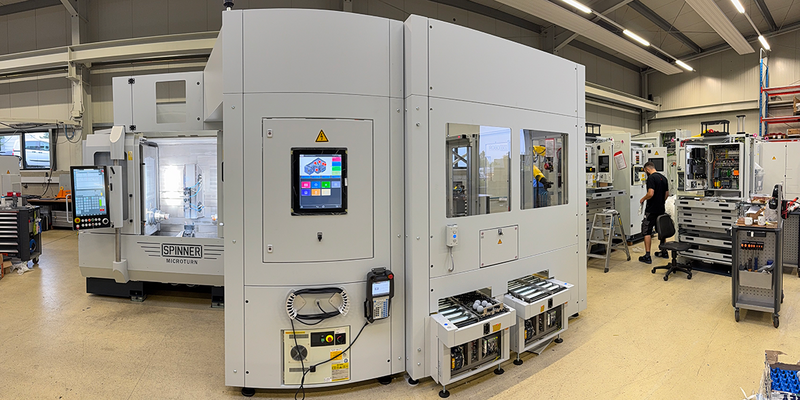
The new production line at Kyocera Fineceramics Medical GmbH is fully designed for the large-scale production of ceramic hip joint balls. At the heart of this project is a SPINNER Microturn, which handles all mechanical machining steps. The pressed blanks reach the machine automatically via a driverless transport vehicle. Each workpiece carrier carries an individual code.
Solution:
The new production line at Kyocera Fineceramics Medical GmbH is designed entirely for the large-scale production of ceramic hip joint balls. At the heart of this project is a SPINNER Microturn, which handles all mechanical processing steps. The pressed blanks are automatically fed to the machine via a driverless transport vehicle. Each workpiece carrier has an individual code, which the system uses to load the necessary component data and automatically set the machining parameters. Once all processes have been completed, this information is reported back in full – for maximum traceability.
Ceramic materials pose special challenges: tension and dust play a key role. A solution was developed together with the customer – including integrated dust extraction and vacuum clamping technology that enables high feed rates and short cycle times despite the sensitive materials.
The result is a state-of-the-art, fully automated production facility that meets the growing demand for high-quality hip prostheses – with minimal staffing requirements, maximum quality and absolute process reliability.
We are proud to be able to contribute to the establishment of this production facility in Germany and to the fact that our neighbourhood will be producing something that contributes to our health in the future – or, in the words of Kyocera: ‘This is where hope for patients is produced’.