Requirements:
1. Machining of thread forming plates
2. Components in different sizes must be manufactured in a chaotic manner
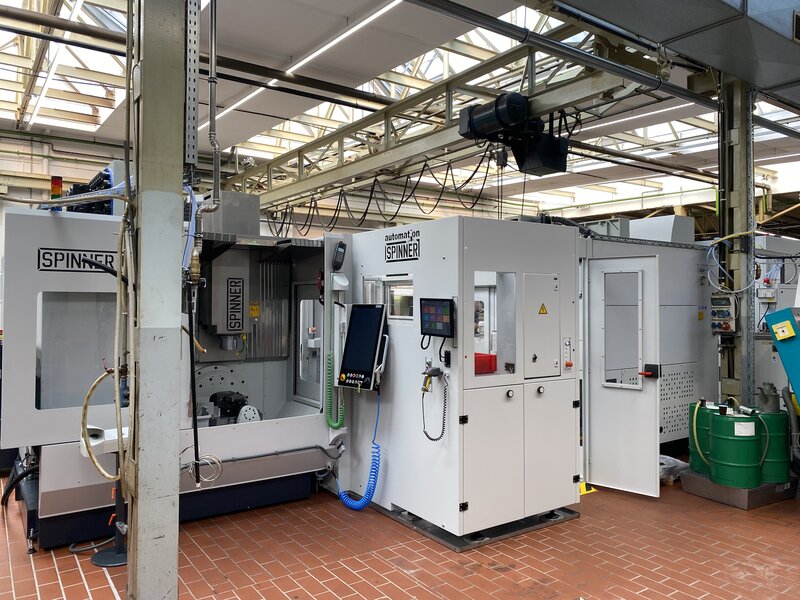
3. Central automation for 2 milling machines
4. Clamp all components with one clamping device without set-up, monitor clamping positions with a position measuring system
5. Complete machining with turning of the components must be possible
Considerations:
A central interface on our software for managing the components and enabling chaotic production will be necessary in order to provide the operator with a simple means of operation.
To achieve flexibility on the robot side, only a system based on servo grippers can be considered. This eliminates the need for gripper changes or replacement parts.
Clamping requires a 2-jaw chuck. To ensure process reliability, the position of the jaws must be measured directly. Accordingly, the transfer option on the table must be enabled for electrical signals.
Solution:
The component dimensions and the requirements for 5-axis machining were ideally suited to the SPINNER U5. The customer needs two machines to achieve the required quantity. However, as the component cycle time is correspondingly high, automation can be achieved using a central robot.
The components themselves are clamped using a special clamping device with a stroke of over 250 mm. This special version of the clamping device is equipped with a direct measuring system for the jaw positions in order to measure the exact jaw position at all times. The electrical signals are transmitted via a coupler system, which has been added to the rotary feed in the table.
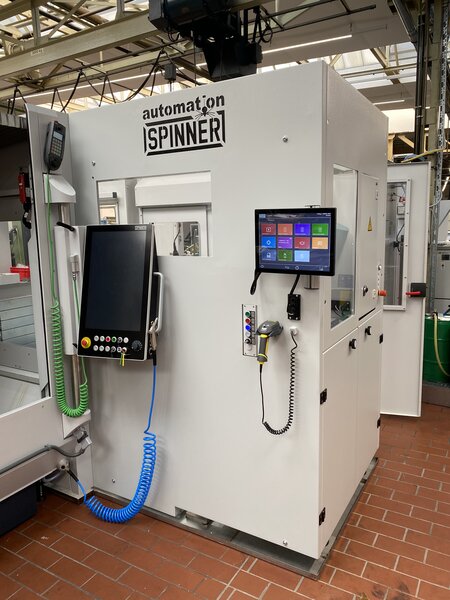
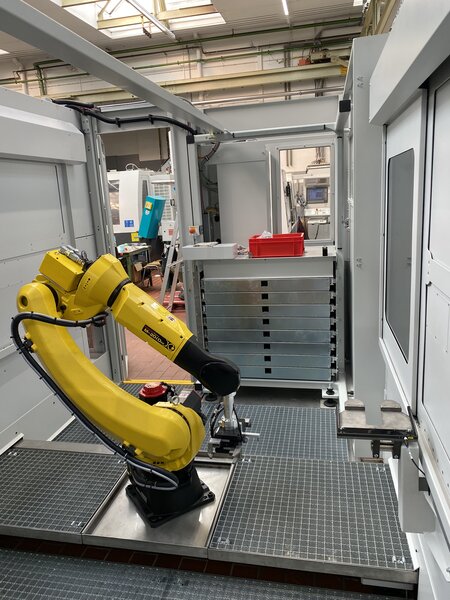
The central automation system has 16 drawers in which the raw parts are stored. Each component can be assigned its own production programme, which is then called up by the PLC when the component is inserted into the machine.
The servo gripper on the robot allows the different component dimensions to be picked up without retooling. Thanks to the integrated force and position monitoring, insertion errors are detected as soon as they occur.
Some of the components require rear-side processing, for which a turning station is included in the cell. The corresponding second processing programme is called up again after insertion into the machine.
The SPINNER automation software is used to operate the system and manage components and orders. The operator uses the software to enter the dimensions of the components and the corresponding production programme on the machine. This data is used to calculate the robot's positions and also to directly determine the clamping data for the clamping devices in the machine. The operator can subsequently see and trace which component was manufactured on which machine.